Introduction
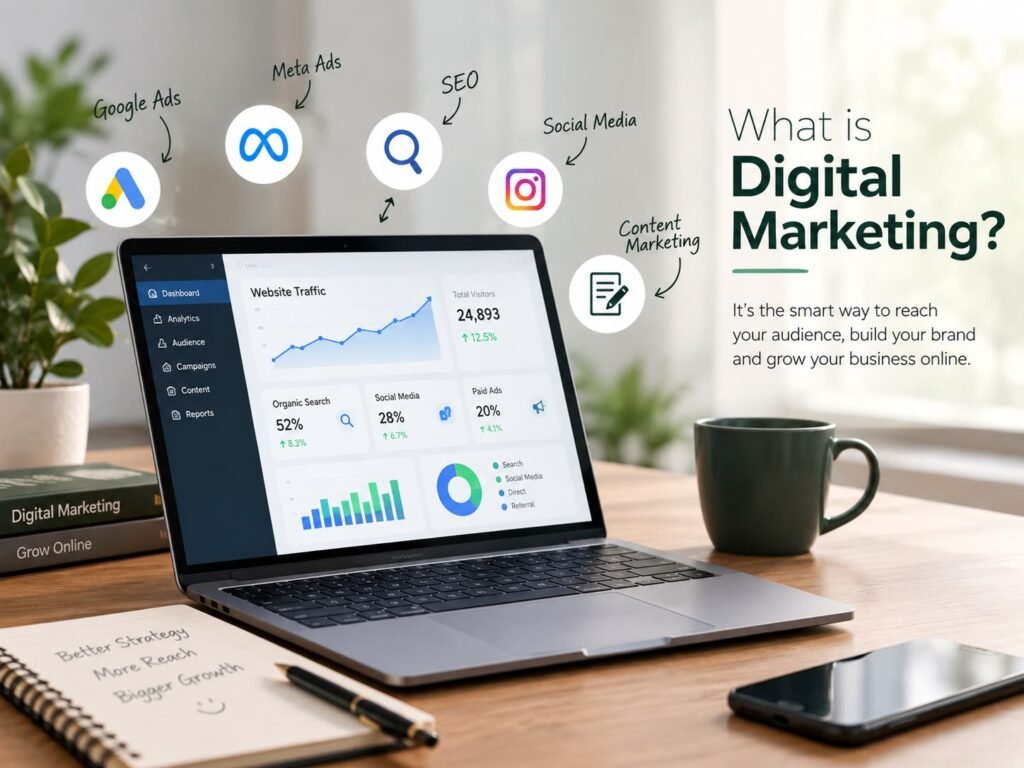
5 Powerful Benefits of Digital Marketing can help businesses grow online, reach the right audience, and build a strong digital presence.Digital marketing is the process of promoting products, services, brands, or businesses through digital channels such as search engines, websites, social media platforms, email, mobile applications, and online advertisements. In today’s technology-driven world, people spend a large amount of time online searching for information, communicating with others, watching videos, shopping, and comparing products. As a result, businesses use digital marketing to reach potential customers where they spend their time.
Traditional marketing methods include newspapers, television advertisements, radio, posters, brochures, and billboards. While these methods are still useful, digital marketing provides businesses with additional opportunities to reach specific audiences, communicate directly with customers, and measure marketing performance.
Digital marketing is not simply about advertising a product on the internet. It is a complete marketing process that includes understanding customers, developing a strategy, creating useful content, promoting products or services, attracting visitors, generating leads, converting customers, and maintaining relationships with existing customers.
Definition of Digital Marketing
5 powerful benifits of digital marketing
Digital marketing can be defined as the use of digital technologies and online communication channels to promote a business, product, service, or brand and achieve marketing objectives.
Digital marketing uses platforms such as:
- Search engines
- Websites
- Social media
- Online advertising platforms
- Mobile applications
- Video platforms
- Online marketplaces
For example, suppose a person wants to buy a pair of shoes. They may search Google for suitable shoes, watch product videos on YouTube, see an advertisement on Instagram, visit an online store, read reviews, and finally purchase the product online. All these digital interactions can form part of a digital marketing strategy.
Why is Digital Marketing Important?
5 powerful benifits of digital marketing
Digital marketing has become important because consumer behavior has changed significantly. People now use smartphones, computers, and other digital devices every day.
Before purchasing a product or service, customers often search online for information. They may compare different brands, check reviews, look at social media pages, and compare prices.
Digital marketing allows businesses to reach these customers during different stages of their buying journey.
1. Large Audience
The internet provides access to a very large audience. A small business can promote its products locally, nationally, or internationally.
2. Targeted Marketing
Digital marketing allows businesses to target specific groups of people based on factors such as location, interests, age, search behavior, and online activity.
3. Cost Effectiveness
Many digital marketing activities can be started with relatively small budgets. Businesses can choose how much they want to spend on advertising.
4. Measurable Results
Digital campaigns can be measured using metrics such as website visitors, clicks, leads, conversions, engagement, and sales.
5. Direct Communication
Businesses can communicate directly with customers through social media, email, websites, and messaging platforms.
6. Better Customer Relationships
Regular communication and valuable content can help businesses build trust and long-term relationships with their customers.
Main Types of Digital Marketing
5 powerful benifits of digital marketing
5 powerful benifits of digital marketing
Digital marketing consists of several different methods. Businesses usually combine multiple methods depending on their goals and target audience.
1. Search Engine Optimization (SEO)
5 powerful benifits of digital marketing
Search Engine Optimization, or SEO, is the process of improving a website so that it can appear more prominently in organic search engine results.
For example, if someone searches for “digital marketing consultant in Calicut,” a digital marketing professional may want their website to appear among the relevant search results.
SEO includes activities such as:
- Keyword research
- Creating useful content
- Optimizing page titles
- Optimizing headings
- Improving website structure
- Internal linking
- Improving website speed
- Mobile optimization
- Building website authority
SEO is generally a long-term strategy. A well-optimized website can attract organic visitors over time without paying for every individual click.
2. Search Engine Marketing (SEM)
5 powerful benifits of digital marketing
Search Engine Marketing involves promoting a business through paid search engine advertising.
For example, when a person searches for “SEO services near me,” paid advertisements may appear at the top of the search results.
Businesses can select specific keywords and create advertisements designed to attract potential customers.
SEM can provide businesses with:
- Quick visibility
- Targeted traffic
- Keyword targeting
- Budget control
- Measurable results
SEO and SEM are different but can work together effectively. SEO focuses mainly on organic visibility, while SEM commonly involves paid search advertising.
3. Social Media Marketing
5 powerful benifits of digital marketing
Social media marketing involves using social media platforms to promote a business and communicate with customers.
Popular platforms include:
- YouTube
- X
Businesses can use social media to share:
- Images
- Videos
- Reels
- Educational content
- Product information
- Customer reviews
- Offers
- Company updates
Social media marketing is not only about selling products. It is also about building a community and creating relationships with customers.
For example, a restaurant can use Instagram to share food photographs, short videos, customer reviews, special offers, and behind-the-scenes content.
4. Content Marketing
5 powerful benifits of digital marketing
Content marketing is the process of creating and sharing useful, relevant, and valuable content to attract a target audience.
Content can include:
- Blog posts
- Articles
- Videos
- Infographics
- E-books
- Guides
- Case studies
- Social media posts
- Podcasts
For example, a digital marketing agency could publish a blog titled “10 Simple SEO Tips for Small Businesses.”
People searching for SEO information may find the article through Google. Some of these visitors may become interested in the agency’s services.
Content marketing therefore helps businesses attract customers by providing value before asking for a purchase.
5. Email Marketing
5 powerful benifits of digital marketing
Email marketing involves sending promotional, educational, or informational messages to customers and potential customers through email.
Businesses can use email marketing to:
- Announce new products
- Send offers
- Share newsletters
- Follow up with customers
- Promote events
- Share useful information
- Maintain customer relationships
For example, an online clothing store may send an email to customers about a new collection or special promotion.
Email marketing can be particularly useful for customer retention because businesses can communicate with people who have already shown interest in their brand.
6. Pay-Per-Click Advertising
5 powerful benifits of digital marketing
Pay-Per-Click, or PPC, is an online advertising model where advertisers generally pay when users click on their advertisements.
PPC advertising can be used on search engines, social media platforms, and other digital advertising networks.
For example, a business selling online courses may create an advertisement targeting people searching for a particular course.
Important PPC measurements include:
- Impressions
- Clicks
- Click-through rate
- Cost per click
- Conversions
- Cost per conversion
- Return on advertising spend
PPC allows businesses to control their advertising budget and monitor campaign performance.
7. Social Media Advertising
5 powerful benifits of digital marketing
Social media platforms provide paid advertising options that allow businesses to reach specific audiences.
For example, a business can create advertisements targeting people based on factors such as:
- Location
- Interests
- Demographics
- Online behavior
- Previous interactions
Social media advertising can be used for:
- Brand awareness
- Website traffic
- Lead generation
- Product sales
- App installations
- Engagement
A small local business can use targeted advertising to reach potential customers in a particular city or region.
8. Video Marketing
Video marketing involves using videos to communicate information about a product, service, or brand.
Video content can include:
- Tutorials
- Product demonstrations
- Educational videos
- Customer testimonials
- Brand stories
- Short-form videos
- Advertisements
Video marketing is effective because visual content can communicate ideas quickly and can be highly engaging.
For example, a beauty brand can create a video demonstrating how to use one of its products. This can educate customers while also promoting the product.
9. Influencer Marketing
Influencer marketing involves collaborating with content creators or individuals who have an established audience.
For example, a fashion brand may work with a fashion creator to introduce its clothing collection to their followers.
Influencer marketing can help businesses:
- Increase brand awareness
- Reach niche audiences
- Build credibility
- Generate engagement
- Promote products
However, choosing an influencer should be based on audience relevance and credibility rather than follower count alone.
10. Affiliate Marketing
5 powerful benifits of digital marketing
Affiliate marketing is a performance-based digital marketing method.
In affiliate marketing, an individual or organization promotes another company’s products or services. When a customer completes a qualifying action through the affiliate’s tracking link, the affiliate may receive a commission.
For example, a technology blogger may recommend a laptop and provide an affiliate link. If readers purchase the laptop through that link, the blogger may earn a commission.
This approach allows businesses to expand their marketing reach while rewarding partners based on performance.
Digital Marketing Process
A successful digital marketing strategy usually follows a series of steps.
Step 1: Identify the Target Audience
The first step is understanding who the business wants to reach.
The marketer may study:
- Age
- Location
- Interests
- Needs
- Problems
- Buying behavior
Step 2: Set Marketing Goals
The business should establish clear goals.
Examples include:
- Increase website traffic
- Generate leads
- Increase sales
- Improve brand awareness
- Increase social media engagement
Step 3: Choose the Right Channels
Not every business needs to use every digital platform. Marketers should choose channels based on where their target audience spends time.
Step 4: Create Valuable Content
Content should address the needs and interests of the target audience.
Step 5: Promote the Content
Content can be promoted through SEO, social media, email, paid advertising, and other channels.
Step 6: Measure Performance
Marketers should analyze campaign results using appropriate metrics.
Step 7: Improve the Strategy
Based on the results, marketers can change their content, targeting, advertisements, website, or overall strategy.
This makes digital marketing a continuous process rather than a one-time activity.
Advantages of Digital Marketing
Digital marketing offers many advantages to businesses.
Global Reach
Businesses can reach customers from different cities, states, and countries.
Specific Audience Targeting
Advertising can be targeted toward audiences who are more likely to be interested in a product or service.
Lower Entry Cost
Businesses can begin digital marketing with a smaller budget compared with some traditional advertising methods.
Measurable Performance
Businesses can monitor campaign results and understand what is generating results.
Higher Engagement
Customers can interact directly with brands through comments, messages, reviews, and other digital channels.
Personalization
Businesses can provide personalized content and offers based on customer interests and behavior.
Flexibility
Digital campaigns can be modified quickly when performance data shows that changes are needed.
Challenges of Digital Marketing
Although digital marketing provides many opportunities, it also has challenges.
High Competition
Many businesses compete for the same customers, keywords, and online attention.
Changing Algorithms
Search engines and social media platforms regularly change their algorithms and features.
Content Saturation
Customers see a large amount of content every day, making it difficult for businesses to stand out.
Privacy Concerns
Businesses need to handle customer data responsibly and follow applicable privacy and advertising requirements.
Continuous Learning
Digital marketing changes rapidly. Marketers need to continuously learn about new tools, technologies, platforms, and consumer trends.
Negative Feedback
Customer complaints and negative reviews can spread quickly online. Businesses need to respond professionally and manage their online reputation.
Role of Analytics in Digital Marketing
Analytics is an important part of digital marketing because it helps businesses understand the performance of their campaigns.
Marketers can measure:
- Website traffic
- Traffic sources
- Social media engagement
- Advertisement clicks
- Leads
- Sales
- Conversion rates
- Customer acquisition costs
- Return on investment
For example, if a company spends money on an advertisement but receives very few leads, the marketer can analyze the campaign and identify possible problems.
Data helps marketers make better decisions instead of relying only on assumptions.
Digital Marketing and Traditional Marketing
5 powerful benifits of digital marketing
Traditional marketing uses channels such as television, newspapers, radio, magazines, posters, and billboards.
Digital marketing uses websites, search engines, social media, email, online advertising, and other digital channels.
One major difference is measurement and targeting. Digital marketing generally provides detailed information about how people interact with campaigns.
For example, a business running a digital advertisement can measure impressions, clicks, conversions, and other performance indicators. Traditional advertising can also be measured, but often with less granular real-time data.
Both traditional and digital marketing can be useful. The best approach depends on the business, audience, objectives, and available resources.
Future of Digital Marketing
Digital marketing will continue to evolve as technology and consumer behavior change.
Artificial intelligence, automation, personalization, video content, conversational marketing, and data analytics are becoming increasingly important.
Artificial intelligence can assist marketers with tasks such as data analysis, content ideation, customer segmentation, automation, and personalization. However, human creativity, strategic thinking, communication, and understanding of customers remain essential.
Future marketers will need to understand both technology and marketing principles.
Conclusion
Digital marketing is the modern approach to promoting businesses, products, services, and brands through digital channels. It includes several important areas such as SEO, SEM, social media marketing, content marketing, email marketing, PPC advertising, video marketing, influencer marketing, affiliate marketing, and analytics.
The main purpose of digital marketing is not simply to increase online visibility. It is to connect the right business with the right audience, provide valuable information, build trust, generate leads, increase conversions, and create long-term customer relationships.
In today’s competitive business environment, having a strong digital presence is extremely important. A well-planned digital marketing strategy allows businesses to understand their customers, reach them effectively, measure their results, and continuously improve their marketing activities.
Therefore, digital marketing is a powerful and measurable way for businesses to grow, build their brand, attract customers, and succeed in the modern digital economy.